
















Dance competitions can be complicated when it comes to scoring dance routines. There are categories and divisions that can get a bit confusing for the audience. That’s why it’s important people are more educated on how it works so they can fully understand the meaning behind every dance routine.
Dance competitions are run by a point system. Let’s start with divisions. Having divisions is crucial because it ensures every dancer is competing against others at the same age and level. Divisions are usually categorized by skill levels, age, dance style, and group size.
First lets start with age as dancers are grouped by age categorizes. Here is how they are normally divided into according to LADanceAcademy:
Age Division
- Minis (5-6)
- Petites (7-10)
- Junior (11-12)
- Teen (13-15)
- Senior (16-18)
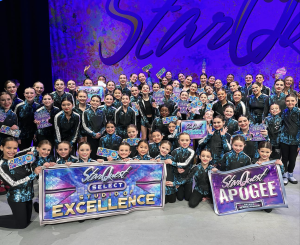
GBSD company after awards with all their accomplishments received by the judges.
Now within every age division they are also categorized by skill level:
- Novice (beginners)
- Intermediate (some experience)
- Advanced (highly skilled)
An obvious one to some is dance style; depending on what style you are performing in, the other competing groups will also perform in the same style (lyrical, tap, ballet, production, etc.).
Lastly they are categorized by group size:
- Solo (one dancer)
- Duet (two dancers)
- Trio (three dancer)
- Small group (4-9 dancers)
- Large group (10-19 dancers)
- Production (20+dancers)
Now that we have covered how they are scored, let’s talk about what the actual scoring looks like. Scores are usually given out with a 100 point scale:
- 35 points: Technical execution
- 35 points: Performance
- 20 points: Choreography
- 10 points: Overall impression (costumes/makeup)
After all the judges have their scores, they later combine scores with all the other judges. Depending on how many judges there are they will each have no more than 100 points to give. Usually there will be only two to three judges, meaning the score will be out of 200 or 300 according to QueenCityDance.
Not only is scoring involved but awards and scholarships are also given out at conventions and competitions. The awards can be given to a whole dance routine or to an individual. These awards are not usually given to the dance routines with the highest score. Here are the most common type of awards:
- Adjudicated Awards (ultimate, high platinum, platinum, high gold, gold)
- Group Awards
- Top Overall Awards
- Studio Awards
- Overall Awards
Lastly, any judge can leave comments about any dance routine, either good or constructive feedback. Every dance convention can differ but this is the generic way scoring works at a dance competition.